Are you looking for a television and two acronyms keep coming up: ULED and QLED. The first is a label from Hisense, the second a technology promoted by Samsung. Behind these four letters, the panels, backlighting, and image processing differ, sometimes less than one might think. Understanding what each term encompasses helps avoid paying a premium for a feature that adds nothing to your living room.
ULED, a Hisense label that encompasses several technologies
QLED refers to a specific type of panel: an LED-backlit LCD screen, where the light passes through a layer of quantum dots to expand the color spectrum. Samsung popularized the term, but other manufacturers use the same technology under different names.
ULED, on the other hand, does not refer to a type of panel. It is a marketing label created by Hisense to describe a combination of treatments: image enhancement algorithms, backlight management, local dimming, and, depending on the range, quantum dots or Mini-LED. In other words, a ULED television can contain a QLED panel inside.
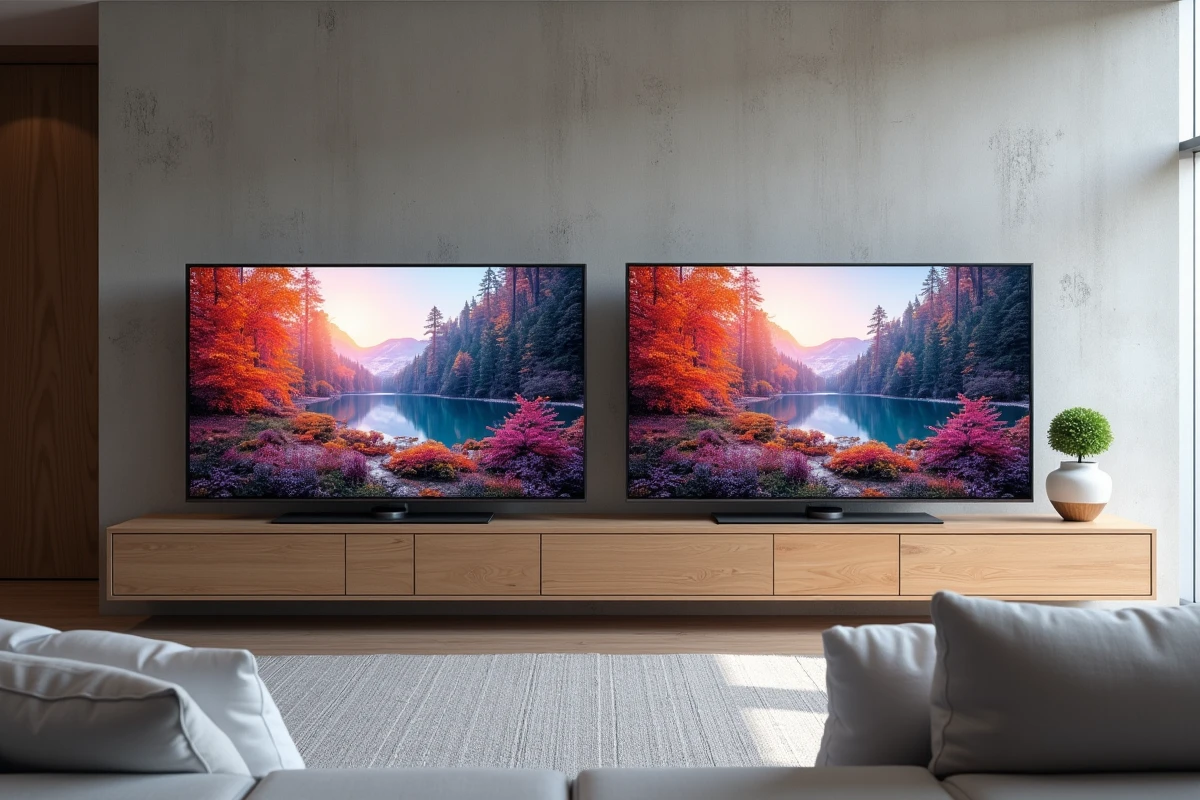
This distinction changes the way to compare. When you put a Samsung QLED face to face with a Hisense ULED, you are not comparing two competing panel technologies. You are comparing two manufacturing approaches: one names the physical layer (the quantum dots), the other names the overall package (panel, backlighting, software processing).
To better understand the differences between ULED and QLED for TV, you need to look at what happens behind the panel, not just the label stuck on the box.

Backlighting and local dimming: what really changes the image
Have you ever noticed gray halos around a bright object on a black background? This flaw comes from the backlighting. The more local dimming zones there are, the more precisely the television can turn off dark areas without affecting bright areas.
Edge LED, Direct LED, Mini-LED
An Edge LED screen places its diodes on the edges. The result is a slim profile, but limited light control. A Direct LED distributes the diodes across the entire back surface, with better control but a thicker chassis.
Mini-LED takes the logic further: much smaller, far more numerous diodes. Hisense’s high-end ULEDs (notably the U8 series) incorporate Mini-LED backlighting. Samsung’s Neo QLEDs do the same. At the high end, ULED and QLED Mini-LED converge in brightness and contrast.
Why local dimming matters more than the number of zones
A high number of zones is not enough. The algorithm that controls the turning on and off of each zone determines the speed of transition and the presence of blooming (those bright halos). Hisense relies on its Hi-View Engine processor to manage dimming. Samsung uses its Neural Quantum Processor.
The result depends on the specific model, not the brand. A mid-range ULED with few local dimming zones will display more blooming than a high-end Neo QLED, and vice versa. Compare the models, not the acronyms.
HDR image quality and color rendering in real conditions
HDR (High Dynamic Range) utilizes the brightness range of the television to display brighter whites and deeper blacks simultaneously. A television that reaches high brightness peaks in HDR renders reflections, sunsets, and high-contrast scenes better.
- Samsung QLEDs support HDR10, HDR10+, and, on some models, HLG. They do not include Dolby Vision, a competing format supported by LG and Hisense among others.
- Hisense ULEDs support HDR10, HDR10+, HLG, and Dolby Vision on most of their recent range. This broader HDR compatibility is a concrete advantage for subscribers to streaming platforms that broadcast in Dolby Vision.
- The color volume (the amount of shades displayable at different brightness levels) depends more on the quality of the quantum dots and backlighting than on the ULED or QLED label.
In real conditions, in a bright room with windows, peak brightness matters more than native contrast ratio. Both technologies perform well thanks to LED backlighting, unlike OLED panels which struggle more in bright light.
Price and value for money: the real criteria for choosing between ULED and QLED
At equivalent diagonal and range, Hisense ULED televisions consistently cost less than Samsung QLED and Neo QLED models. This pricing strategy is the main reason why Hisense has gained market share in recent years.
This price gap does not mean that the image is inferior. Independent tests show that recent Mini-LED ULEDs achieve HDR brightness and contrast performance comparable to mid-range and high-end Samsung Neo QLEDs. The difference lies in other areas:
- The software interface: Samsung uses Tizen, Hisense uses VIDAA (or Google TV depending on the markets). Tizen offers a more mature ecosystem and SmartThings integration.
- Finish and design: Samsung invests more in chassis thickness, screen bezels, and cable management.
- Software update tracking, generally longer for Samsung on its high-end models.
If your priority is image quality per euro spent, Hisense ULEDs offer a better value. If you value the connected ecosystem, design, or software support, Samsung QLEDs justify their premium.
The choice between ULED and QLED rarely boils down to a question of pure display technology. At comparable ranges, the panels and backlighting increasingly resemble each other. What separates the two is the purchase price, HDR compatibility, operating system, and your daily usage habits. Identify these priorities before looking at the technical specifications, and the acronym on the box will matter less.