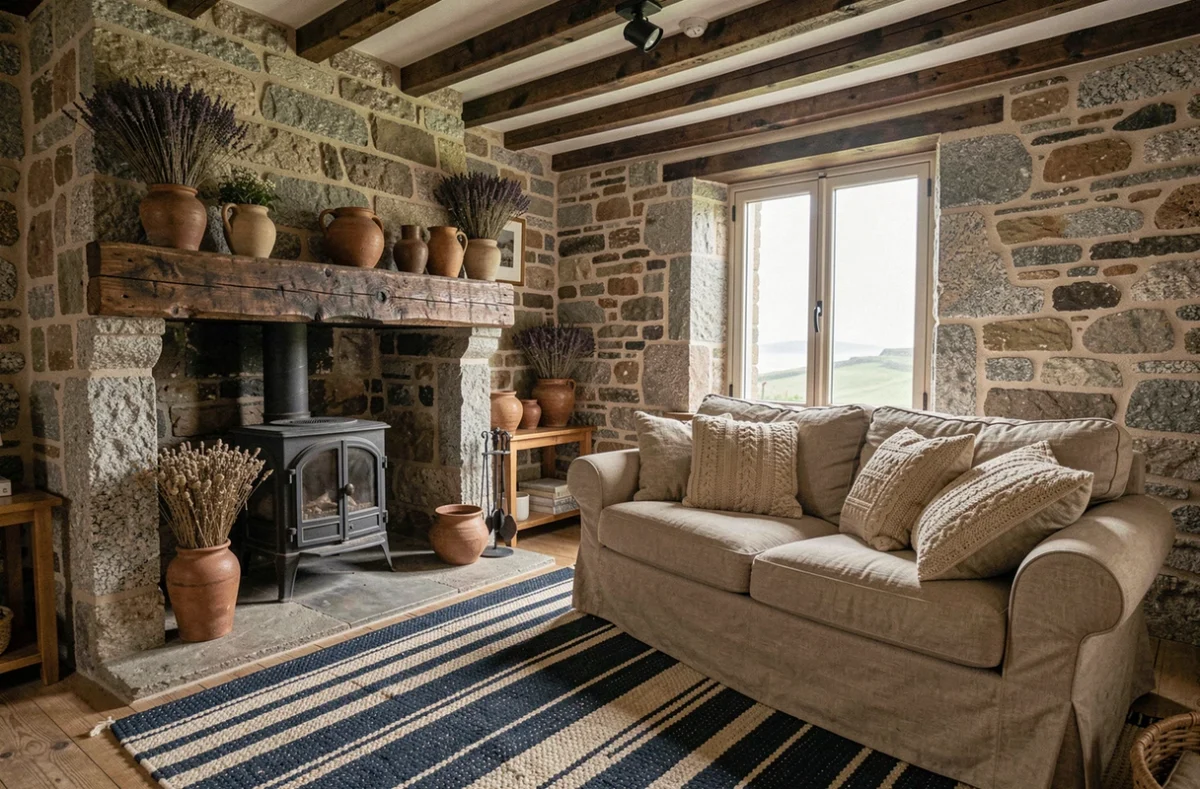
Furnishing a house in Brittany raises a question that decoration magazines often sidestep: how to reconcile the charm of old buildings, the humidity of the Atlantic climate, and current thermal requirements? The answer goes beyond the choice of paint color or a linen sofa. It begins with technical decisions that directly affect the comfort experienced on a daily basis.
Humidity and insulation in Brittany: diagnosis before decoration
Several recent sources of expertise remind us: insulating a damp wall traps the problem and promotes condensation, mold, and degradation of interior finishes. In Brittany, where annual rainfall far exceeds the national average, this point becomes a prerequisite for any interior design project.
Specifically, a granite or schist wall that shows rising damp must be treated before any insulation is installed. Address the humidity first, insulate second: the reverse order creates an interior that feels warm for the first few weeks, then becomes uncomfortable and costly to rectify.
Ventilation is part of this decision-making process. Recent regulations now incorporate mechanical ventilation (VMC) into overall renovation projects, rather than as an isolated gesture. For a house on Terre de Breizh, whether it’s a longère in Finistère or a village house in Côtes-d’Armor, the insulation-ventilation combination determines the warmth felt much more than the choice of furniture.
Biosourced materials suitable for the Breton climate: comparison
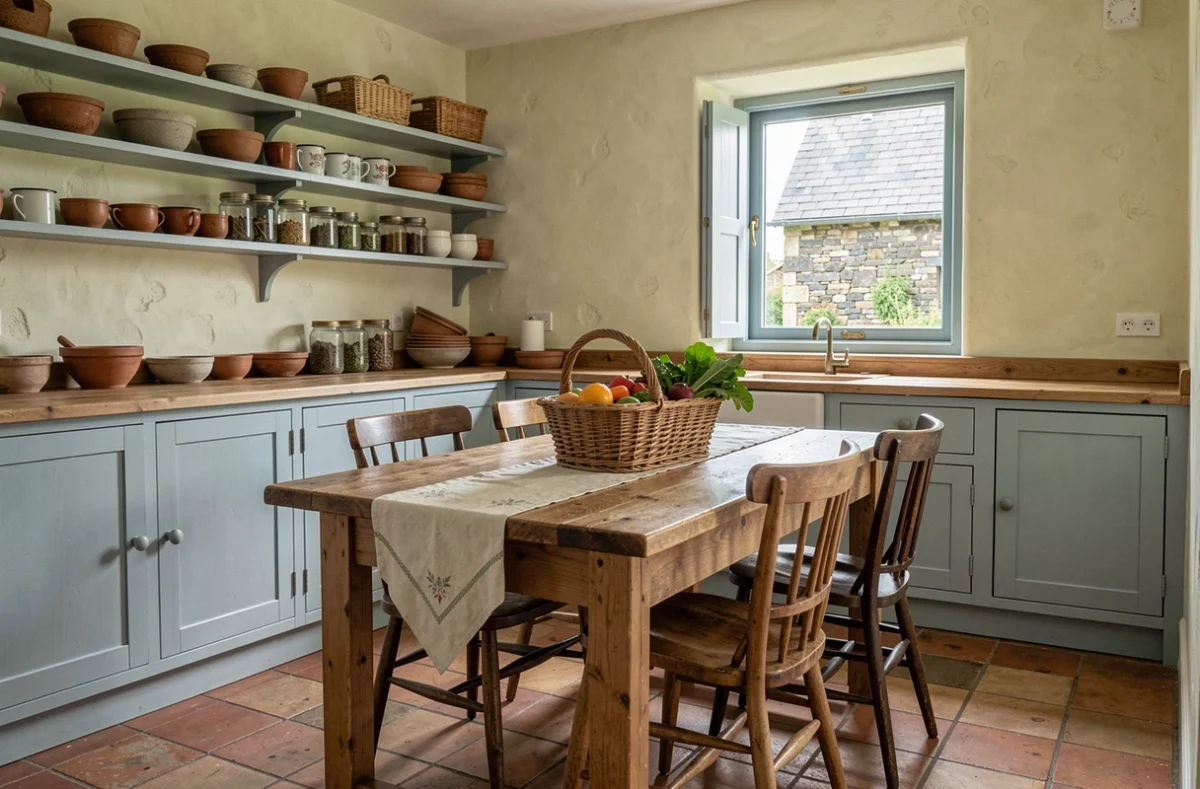
The choice of insulation affects humidity regulation. Biosourced materials have a documented advantage for old Breton buildings: they allow water vapor to migrate instead of trapping it.
| Material | Humidity Regulation | Compatibility with Stone Walls | Possible Regional Origin |
|---|---|---|---|
| Wood Fiber | Good (active capillarity) | High | Yes (Brittany/Loire Valley supply chains) |
| Hemp | Very good | High (lime-hemp plaster) | Yes (documented local cultivation) |
| Cellulose Wadding | Fair | Medium (risk of settling in the wall) | Not specifically regional |
| Glass Wool | Low (vapor barrier required) | Low (blocks migration) | No |
Hemp and wood fiber stand out for their ability to regulate humidity without a waterproof vapor barrier, which preserves the hygrothermal function of a stone wall. Glass wool, on the other hand, requires a vapor barrier that can trap water in the wall, exactly the scenario to avoid in an old Breton house.
Lime-hemp plaster deserves special mention. Applied directly to the stone, it provides moderate insulation but continuously regulates humidity. For a north-facing living room or bedroom, this solution is sometimes enough to transform a cold, damp wall into a dry and pleasant surface to the touch.
Stone, wood, and slate: creating a warm atmosphere without marine clichés
Once the structure is treated, the choice of visible materials defines the atmosphere. Brittany offers a unique architectural vocabulary, but the trap is to reduce this vocabulary to decorative accessories.
Exposed Granite and Schist
Leaving a raw stone wall in a living space provides thermal mass that stabilizes indoor temperature. An uncoated granite wall acts as a passive thermal regulator, cool in summer and slowly releasing heat in winter, provided it is properly pointed with lime.
A common pitfall: pointing with Portland cement, which waterproofs the wall and prevents the stone from breathing. Natural lime remains the suitable binder for Breton buildings.
Wood and Interior Joinery
Oak and chestnut dominate the traditional frameworks and joinery of the region. Rather than adding new paneling to a healthy wall, enhancing existing beams by stripping them (without painting them white systematically) produces a more coherent result.
- Chestnut, naturally rot-resistant, is suitable for areas exposed to moisture such as entrances or adjoining laundry rooms.
- Oak, denser, is suitable for visible structural elements: lintels, floor beams, fireplace surrounds.
- Locally reclaimed wood (barn beams, old doors) brings a patina that is impossible to reproduce with new materials and fits into a reuse logic.
Slate: dosage and placement
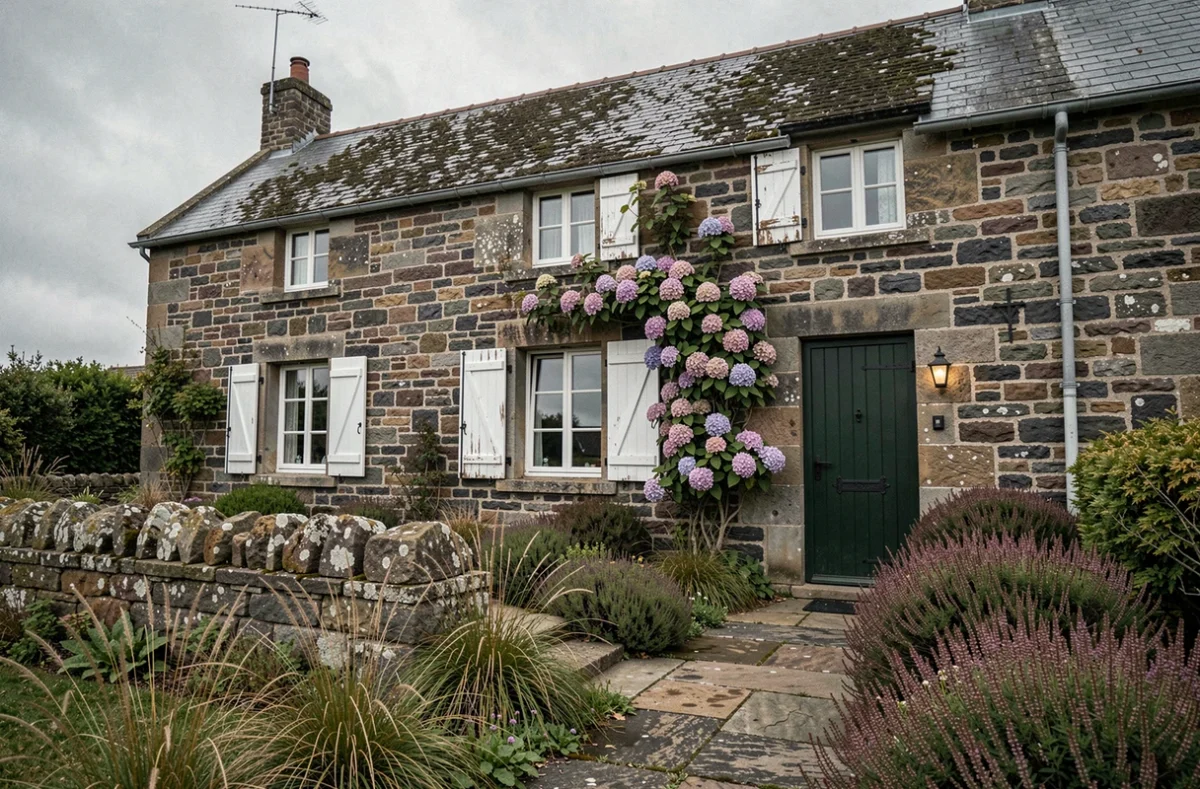
Slate is ubiquitous on roofs, but its use in interior decoration requires restraint. A countertop or fireplace top made of local slate is enough to anchor the interior in its regional context. Multiplying slate surfaces (floor, backsplash, shelves) creates a dark and monotonous effect, especially in the less bright rooms of northern Finistère.
Energy renovation in Brittany: aids and constraints to consider
Energy renovation aids have recently evolved, with new rules more explicitly integrating ventilation into overall projects. For Breton homeowners, this means that insulation and ventilation work must be considered together to benefit from aid schemes.
Regulatory constraints also push for an energy diagnosis before work begins. In the case of a stone house, this diagnosis often reveals a poor energy performance certificate (DPE) related to thermal bridges from thick, uninsulated walls. The decision then revolves around the choice between interior insulation (which reduces living space but preserves the facade) and exterior insulation (which alters the exterior appearance, sometimes subject to the opinion of the Architects of the Buildings of France).
- In protected areas (surroundings of monuments, remarkable heritage sites), exterior insulation is often refused, directing towards interior solutions compatible with stone.
- Insulating plasters based on lime and hemp constitute a compromise accepted by many Breton municipalities.
- Installing a humidity-controlled VMC, adapted to seasonal humidity variations, completes the system without excessively drying the indoor air.
The thermal comfort of a Breton house relies on this balance between insulation, ventilation, and breathable materials. Decorating before addressing these parameters is like dressing a house that doesn’t function. Aesthetic choices, from exposed granite to oak furniture, only produce their warm effect in a properly treated and ventilated interior.