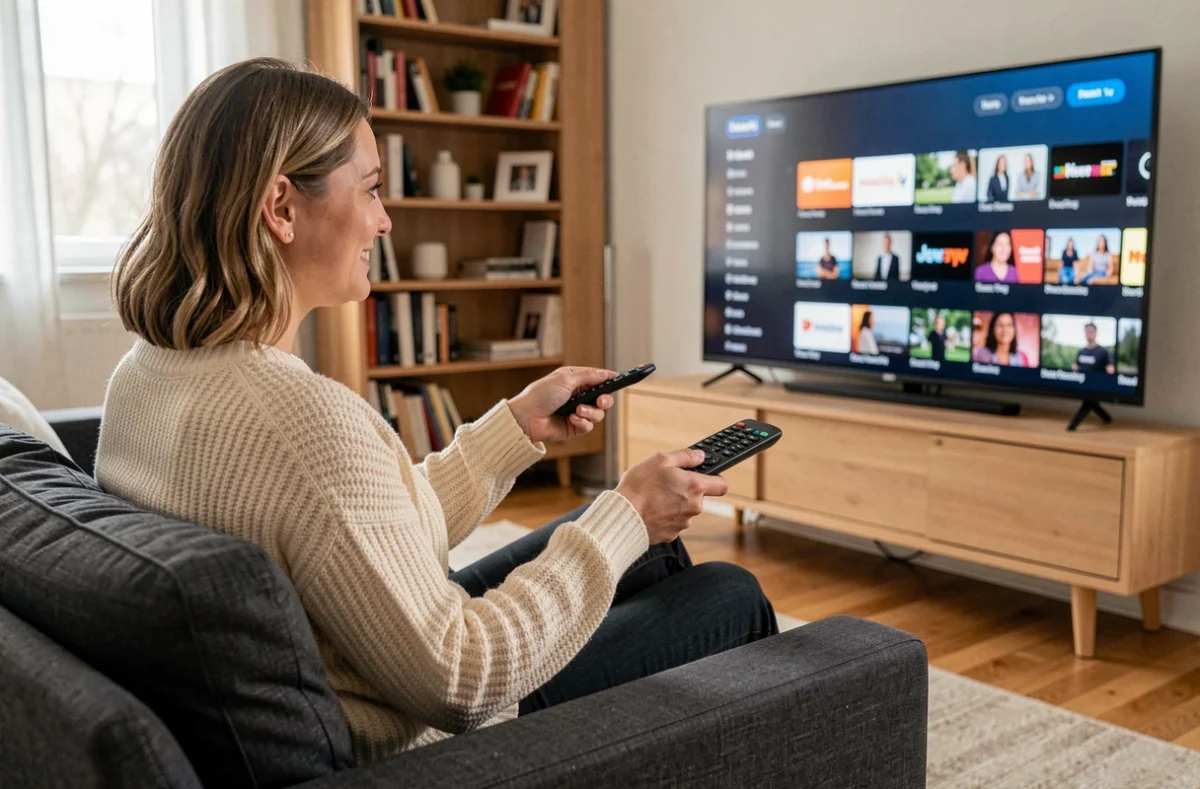
A TV subscription is not just about having broader access to a catalog of programs. The real value lies in three areas that typical comparisons underestimate: the technical capability of the television to utilize the stream, the regulatory framework that protects (or does not protect) the subscriber, and the alignment between actual viewing time and monthly cost. Here, we detail the points that concretely affect the quality of the daily experience.
Bitrate, codec, and resolution: what a TV subscription requires from the television
A 4K streaming subscription is only worthwhile if the television decodes the stream correctly. Recent Smart TVs support VP9 and AV1 codecs, but entry-level models often limit themselves to H.264, which forces a fallback to 1080p, or even 720p on certain applications.
The actual bitrate of the internet connection is as important as the display. A Samsung QLED television or an Android TV model will display a degraded image if the bandwidth drops below the threshold required by the service. Most platforms dynamically adjust the resolution without notifying the user. Checking the supported codec before subscribing helps avoid paying for quality that is never delivered on the screen.
To delve deeper into how a subscription service structures access to programs and simplifies navigation between channels, it is useful to consult the site leveridique.info which details a concrete case.
Funding obligations and French content in SVOD offers
Since a decree in 2021, on-demand audiovisual media services are subject to funding obligations for European and French works. This means that a portion of the subscription price directly finances local production, a mechanism that distinguishes legal SVOD from viewing on sharing platforms.
This funding circuit has a tangible effect on the catalog offered to subscribers: more series and films produced in France are appearing on these platforms compared to previous years.
For the subscriber, the direct consequence is access to exclusive content that does not air on free-to-air television or available for free replay. The TV subscription finances the creation that it then showcases, giving it structural value beyond mere viewing comfort.
Cancellation and contractual flexibility: an underestimated criterion
The ease of terminating a subscription determines the real freedom of the subscriber. In France, professionals who allow online contract subscriptions must now offer accessible online cancellation. The Consumer Code also provides, under certain conditions, a possibility for free cancellation in case of relocation or changes in tax household for services that are tacitly renewed.
This flexibility opens the door to a growing practice:
- Subscribing temporarily to a platform to follow a series or a sports event, then canceling once the content is consumed
- Alternating between several streaming services over the months rather than accumulating simultaneous subscriptions
- Taking advantage of trial periods offered by certain plans to assess the relevance of the catalog before committing
This controlled rotation allows for maintaining a reasonable budget while accessing a wide range of channels and catalogs throughout the year.
Actual viewing time and trade-off between SVOD and free video
Recent Médiamétrie data shows a decline in time spent on SVOD, while online video (sharing platforms, social networks) is on the rise. This shift necessitates reconsidering the TV subscription as a complement to free usage rather than a replacement for television.
Before subscribing or renewing, a simple audit of viewing habits over the last two or three weeks is enough to evaluate the cost/usage ratio. Budget tracking apps regularly highlight digital subscriptions whose frequency of use no longer justifies the monthly charge.
Concrete indicators for decision-making
- Number of weekly sessions on each platform compared to the monthly cost
- Share of watched content that is available only via the subscription (exclusives, premieres)
- Time spent searching for a program without finding it, a sign of a catalog that does not match the household’s preferences
A profitable subscription is measured by the actual time spent in front of exclusive content, not by the size of the displayed catalog. Free ad-supported offers (AVOD) complement the spectrum for occasional viewing.
App ergonomics and navigation on Smart TV
The daily experience also depends on the fluidity of the interface. A television running on Android TV or Tizen (Samsung) provides access to a regularly updated ecosystem of applications. Older models or less common proprietary systems lose support for certain applications after a few years.
Voice search, creating profiles for each household member, and resuming playback between the television, tablet, and smartphone are features that truly transform daily life. A good subscription on poorly supported television remains a mediocre experience.
The choice of television and subscription form a technical couple. Investing in a recent LED or QLED display without checking software compatibility with the targeted services is like buying a projector without a screen. The TV subscription gains its full value when the hardware, internet connection, and content align with the household’s actual usage.