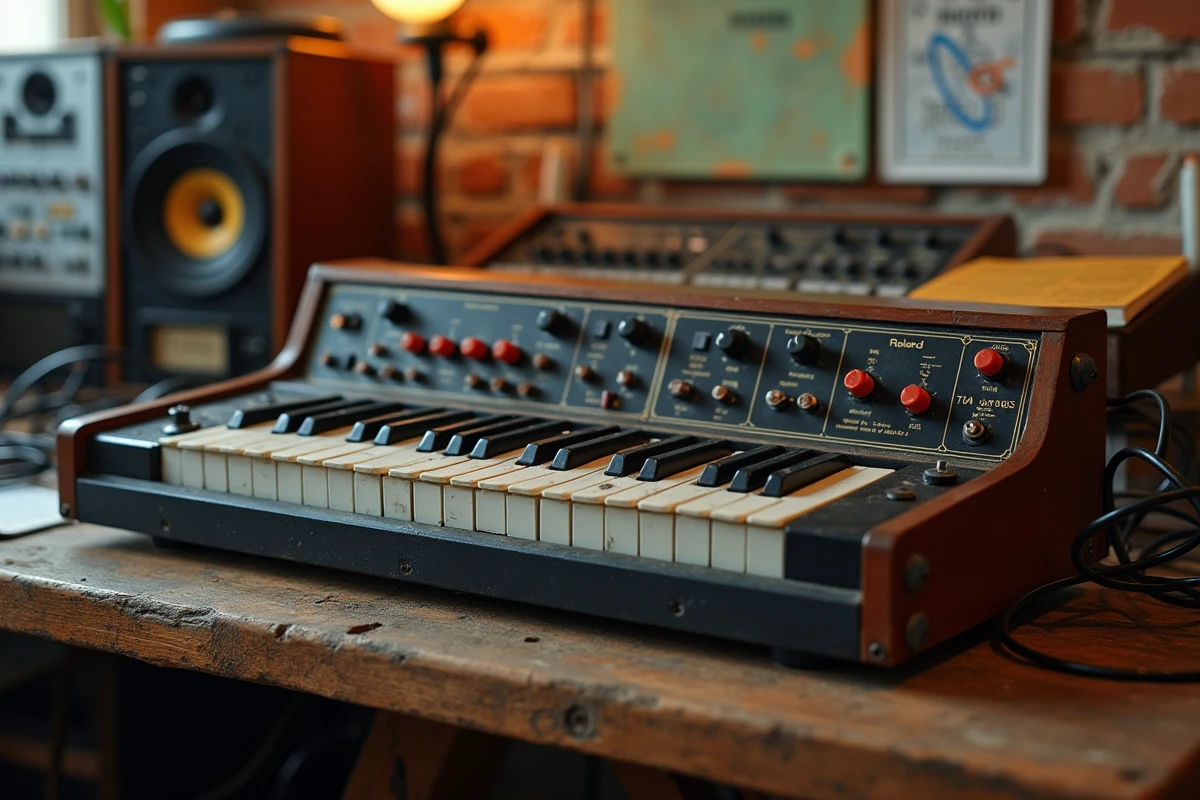
When you open a project in a DAW and load a drum kit labeled “808,” you’re not just manipulating a simple preset. You’re activating a sonic legacy that has spanned four decades, multiple continents, and a dozen musical genres. The name 808 refers to the Roland TR-808, an analog drum machine whose deep, long kick has become a recognizable signature in mere milliseconds.
An analog drum machine with accidentally unique sound
The story of the TR-808 begins at Roland, which sought to produce drum machines accessible to the general public in the years leading up to its release. The device relied on analog synthesis, not on recorded samples.
The kick produced a deep sine wave capable of reaching sub-bass frequencies, a tonal quality that distinguished the machine from all its competitors of the time.
You can delve into the origin of the name 808 on Web United to understand how the technical designation of the model became a common term in music production.
Upon its release, the TR-808 was, however, a commercial failure. Session musicians and professional studios criticized it for its overly artificial sounds, which were far from a real acoustic drum kit. Production was halted after just a few years, leading to a paradoxical consequence: unsold machines found their way onto the second-hand market at very low prices, accessible to independent artists, DJs, and emerging hip-hop producers.

Roland TR-808 in hip-hop and electronic music
Early hip-hop, followed by Miami bass and electro, were the first genres to massively exploit the TR-808. Africa Bambaataa with “Planet Rock” popularized the machine to a wide audience. The deep kick allowed sound systems at block parties and clubs to vibrate, where an acoustic kick lacked power in the low frequencies.
The TR-808 laid the rhythmic foundations of house and techno. In Detroit and Chicago, producers built their first tracks around its programmable rhythms. The ability to sequence patterns without a live musician transformed the relationship to composition: one person, an apartment, and a drum machine were enough to produce a complete track.
From rare hardware to sample packs
With the cessation of production, used TR-808s saw their value soar. Producers who did not have access to the physical machine began sampling its sounds and then distributing them in the form of sample packs. This shift from hardware to software exponentially multiplied the dissemination of the 808 sound.
Today, nearly all DAWs include kits derived from the TR-808. Dozens of VST plugins reproduce or reinterpret its timbres. Roland has also responded to this demand with the TR-08, a compact version of the Boutique line that captures the sound engine of the original in a modern format.
The 808 kick in modern production: a sound that has become a category
The semantic shift around the word “808” deserves attention. In a studio in 2025, saying “808” no longer refers to the Roland machine. The term refers to an entire category of long, tunable synthetic basses, used as the harmonic foundation of a track.
In trap, the 808 kick is not just a percussive element. It replaces the traditional bass line. It is tuned to the key of the track, its ADSR envelope is managed to control the attack and sustain, and its saturation is worked on so that it translates well on small speakers as well as on a club system.
Technical constraints of mixing 808
Getting an 808 to sound right requires specific work on several points:
- The sidechain between the kick and the 808 bass avoids frequency conflicts that muddy the low end
- Harmonic saturation adds frequencies in the midrange, making the bass audible on smartphone speakers or cheap headphones
- Adjusting the envelope (decay and sustain) determines whether the 808 sounds like a short, percussive kick or like a sub-bass pad
- The choice of the starting sample conditions everything else, as a poorly recorded or overly compressed 808 limits processing possibilities
Opinions vary on this point: some producers prefer to synthesize their 808 from a pure sine wave, while others systematically start from a sample taken from the original machine. Both approaches yield usable results, but the texture differs.
Presence of the 808 sound beyond trap and hip-hop
Limiting the 808 to hip-hop would ignore its massive adoption by global pop, afrobeats, and EDM. Mainstream tracks incorporate 808 basses without the listener consciously identifying the lineage with an analog drum machine from the 1980s.
This dissemination has a concrete effect on audio production: sound engineers now calibrate their mixes considering the almost systematic presence of 808 sub-basses. Mastering standards for streaming platforms incorporate this reality, as a track with a poorly managed 808 loses impact after loudness normalization.
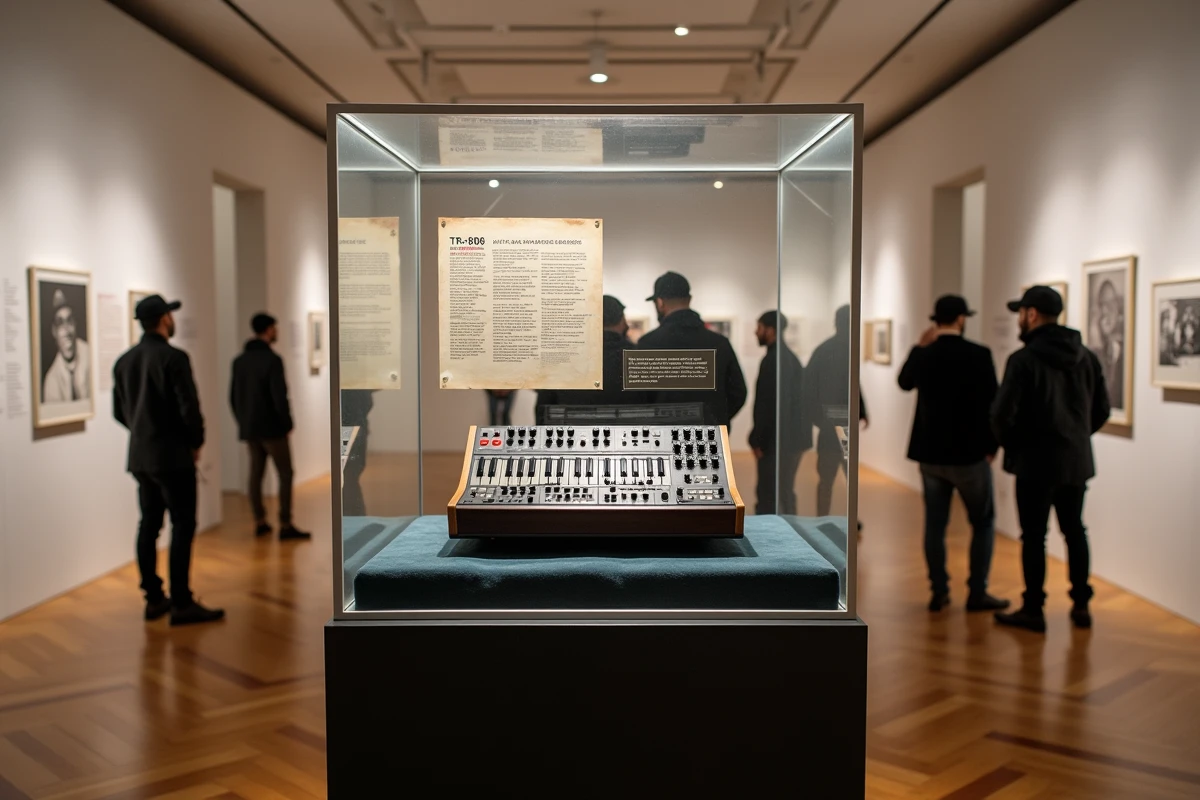
The TR-808 has also marked culture beyond the studio. “808 Day,” celebrated every year, reflects the attachment of the producer and beatmaker community to this instrument. Roland maintains this legacy with regular reissues and collaborations that keep the machine relevant in the music scene.
Forty years after the cessation of its production, the TR-808 remains a unique case: a commercial failure transformed into an industry standard. Its kick has redefined what “bass” means in popular music, and the word 808 itself has transitioned from technical jargon to everyday language in production, understood from Tokyo to Lagos to Atlanta.