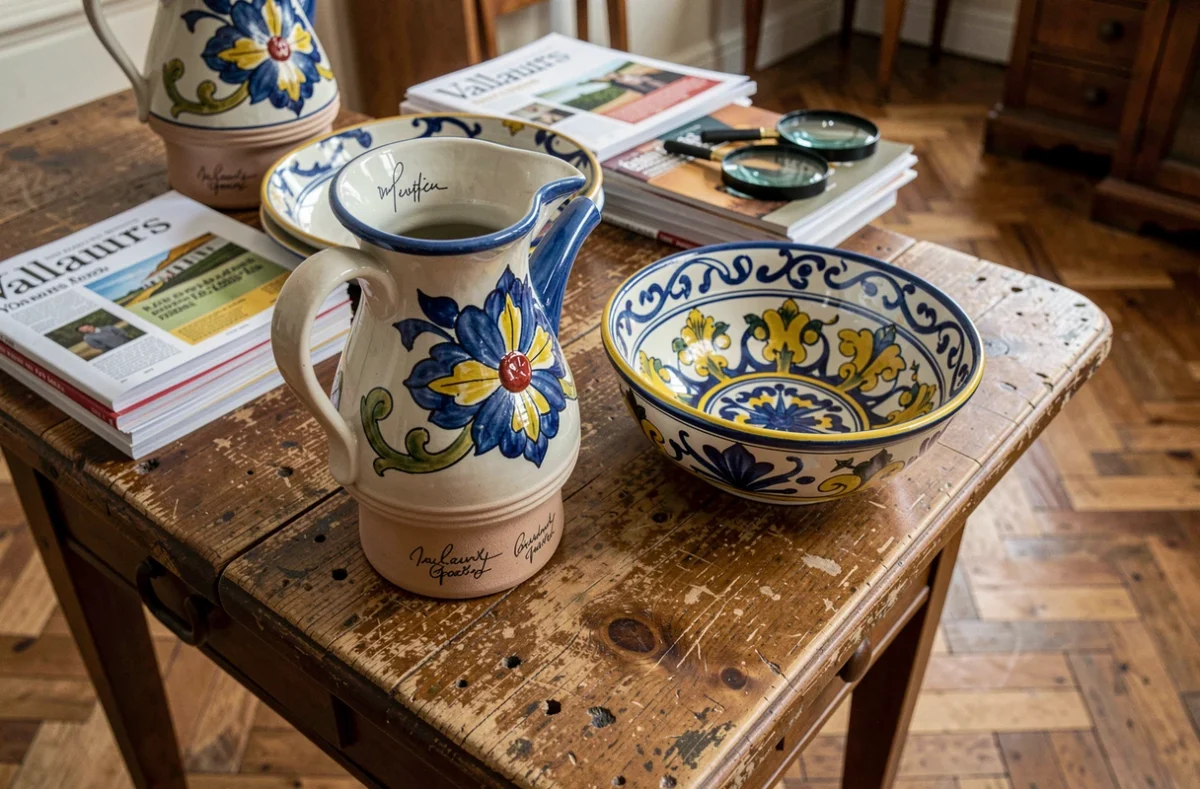
At a flea market or auction house, you regularly come across ceramics stamped “Vallauris.” The asking price can range from a few euros to several thousand, often based solely on a name engraved on the underside. The problem is that a legible signature guarantees neither the maker nor the value. Understanding the difference between a place name and a verifiable attribution is the first step before paying a premium for the name of a Vallauris ceramicist.
Signature, attribution, place mark: three levels of evidence on Vallauris ceramics
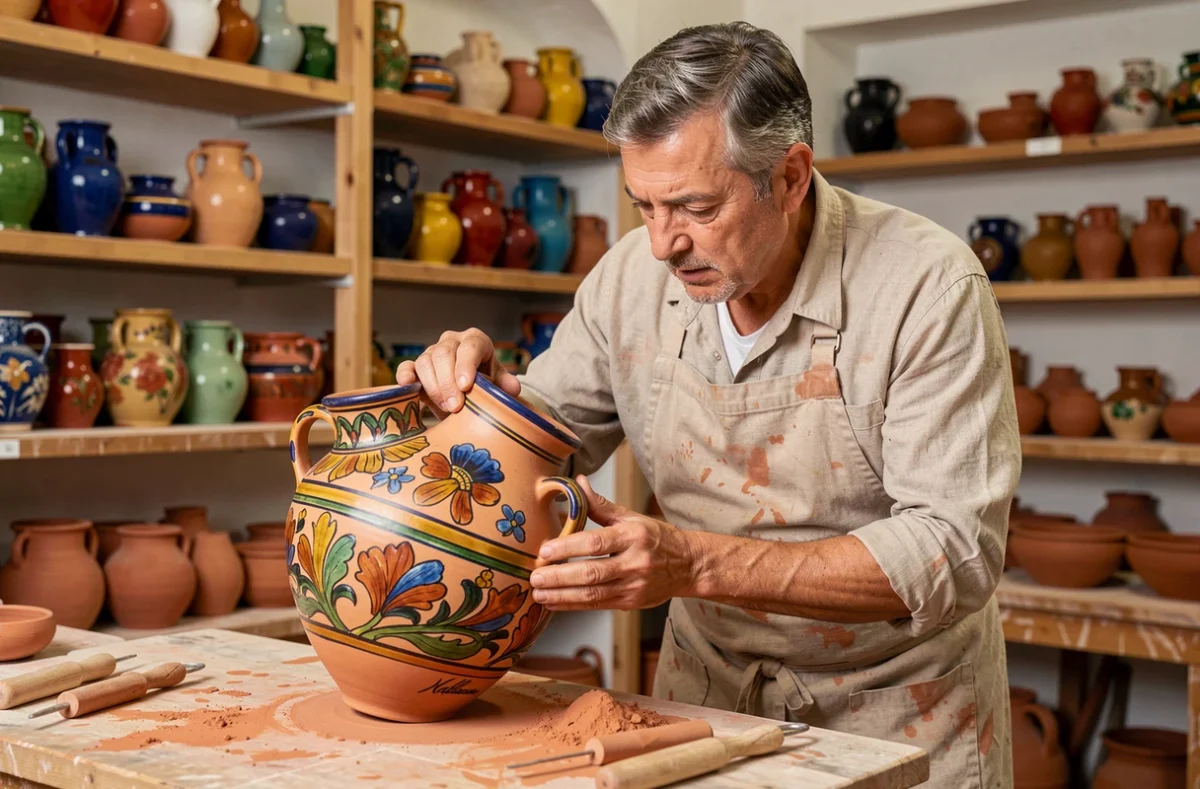
The word “Vallauris” on the underside of a vase or dish indicates its geographical origin. It does not identify an artist or a specific workshop. Hundreds of potters have worked in the town since the postwar period, and many simply stamped the town’s name on their everyday production.
One step up is a plausible attribution. A seller links the style of the decoration and the shape of the vase to a well-known name, such as Marius Bessone. On some resale listings, the attribution is based on visual similarities to documented pieces, without independent appraisal. It is not proof, but a hypothesis.
Documented authentication, by contrast, requires a body of corroborating evidence: a legible signature, cross-references to a catalogue or directory of forms, and traceable provenance (purchase invoice, exhibition certificate, public auction history). For the most sought-after Vallauris signatures, the distinction between attribution and authentication can radically affect a piece’s market value.
Before paying a premium, ask for physical evidence—not just a name beneath the glaze.
Picasso and Madoura ceramics: what the stamps really tell you
Pieces made at the Madoura workshop for Picasso attract collectors’ attention, but they are also the source of some of the costliest misunderstandings. Several stamps are used: “Madoura Plein Feu,” “Édition Picasso,” and “Empreinte originale de Picasso.” Each refers to a different type of production.
An “original impression” means that Picasso created the model himself, after which the Madoura workshop produced copies. The number of copies in an edition varies by model. Confusing the Ramié catalogue model number with the edition number can lead you to compare objects that have nothing in common, or to overestimate a piece’s rarity.
Alain Ramié’s catalogue lists the models Picasso created in Vallauris. Each model has its own number. The edition number, meanwhile, indicates an individual piece’s place in the production run. A knowledgeable buyer checks both references and compares them with the piece’s dimensions, technique, and decoration before accepting an attribution.
What to check before buying a Madoura edition
- The stamp on the reverse: “Madoura Plein Feu” or “Édition Picasso,” with lettering and placement consistent with documented examples of the same model.
- The model number in the Ramié catalogue, cross-checked against the dimensions and decoration of the piece being examined.
- Provenance: a public auction history or an earlier purchase invoice helps establish traceability, while a piece with no history at all calls for greater caution.
- Condition: restorations, chips, or overpainting can affect value, even for an authentic piece.
Recent auction results for Madoura ceramics have exceeded estimates, but they concern a small sample of objects that vary considerably. They cannot be used to infer a general market trend.
Roger Capron, Massier, Bessone: the names that shape Vallauris prices
Beyond Picasso, several Vallauris ceramicists have an established profile at public auctions. Roger Capron remains one of the most sought-after names. His ceramic-tile coffee tables and orangeade sets regularly appear in Drouot catalogues. Polychrome geometric decoration and the incised “Capron Vallauris” signature are reliable visual clues, but the signature alone is still no substitute for checking whether the piece is consistent with known series.
The Massier family holds a special place in the history of Vallauris ceramics. Jérôme Massier, Clément Massier, and their descendants produced pieces with iridescent glazes and naturalistic decoration from the 19th century onward.
On the secondary market, a piece bearing the signature “Jérôme Massier,” accompanied by a description of its decoration, does not amount to an independent appraisal. Attribution often relies as much on the style of the decoration as on the mark, leaving room for uncertainty for non-specialist buyers.
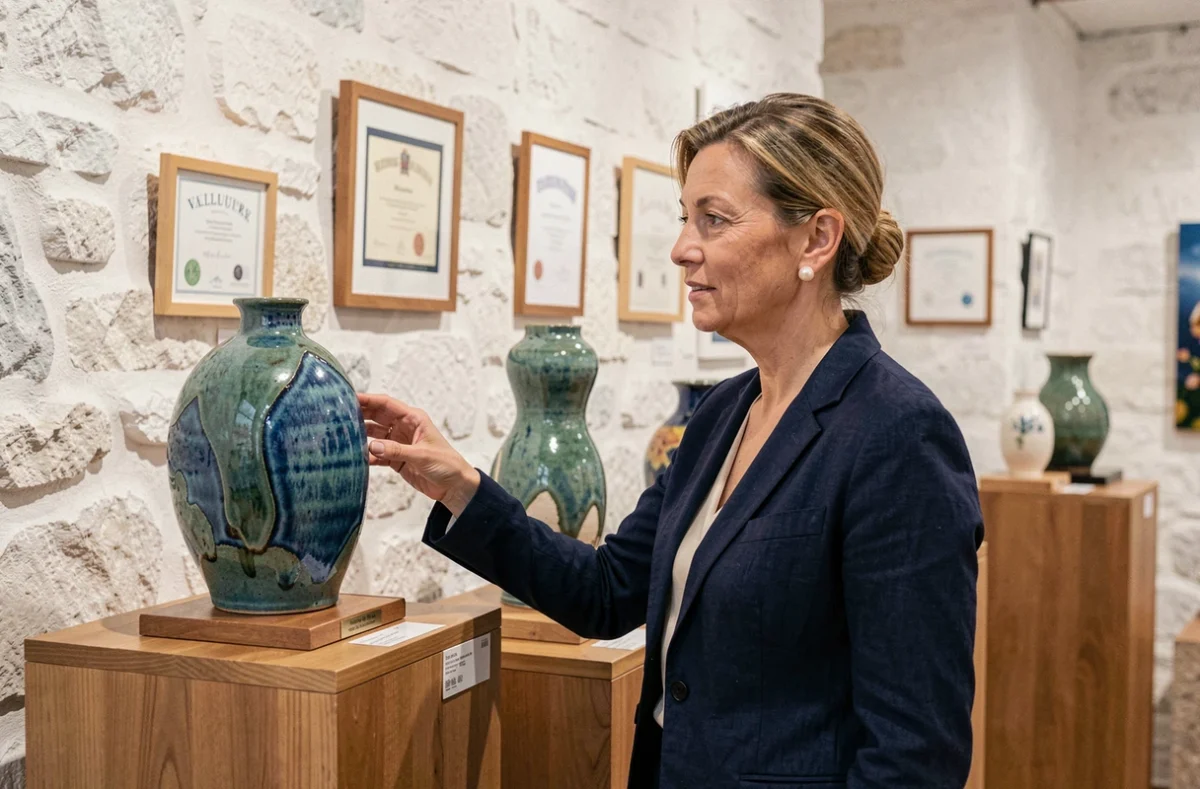
Marius Bessone, Jean Lurçat (for his ceramic collaborations), François Raty, and names such as Dominique Azaïs and Paul Jourdan also feature in collectors’ searches. The value of their pieces depends heavily on the period of production, the type of decoration, and the condition.
What drives up the value of a signed ceramic piece
A name alone is not enough to value a Vallauris piece. Compare the mark against several concrete criteria:
- Shape and technique (slip, glaze, glazed earthenware, stoneware), compared with documented pieces by the same ceramicist.
- Decoration: a rare motif or limited series is worth more than a standard production piece.
- Condition: cracks, restorations, and chips reduce value, sometimes significantly.
- Comparable sales: a recent auction result for a similar object is a more reliable benchmark than a gallery asking price.
Buying a sought-after Vallauris ceramic: what to do on the spot
Whether you spot a signed piece at a fair, flea market, or online, follow the same steps. Turn the object over, photograph the signature and any stamps, and measure the piece. These details help identify the model in a catalogue or directory of forms.
If the seller names a maker (Capron, Massier, Bessone), ask what the attribution is based on. “It’s the style” is not as convincing as a certificate, an original invoice, or a documented public auction record. On resale platforms, the way a signature is presented for sale may itself be uncertain: it is up to the buyer to distinguish between a claimed attribution and documented authentication.
For pieces believed to be highly valuable, consulting an expert in 20th-century ceramics (a member of a professional association or affiliated with an auction house) remains the most reliable approach. The cost of an appraisal is worthwhile as soon as the asking price exceeds a few hundred euros.
Vallauris ceramics remain a market where knowledge of the makers, forms, and techniques matters just as much as the name engraved beneath the glaze. A well-documented piece is always worth more than an isolated signature.